Best Lovable Alternatives in 2026
Compare the best Lovable alternatives in 2026, including Layerwise, v0, Bolt, Replit, Base44, and Claude Code, on model choice, pricing, and trade-offs.
Table of contents
The right Lovable alternative depends on what you want more control over: the AI model, where your code lives, how you pay for usage, or the stack your app runs on. This guide compares six options against Lovable, starting with Layerwise, which we make.
Lovable turns a description into a full-stack web app with a built-in backend and hosting. For many projects, that is the right fit. Other people reach a point where they want to pick the building model, work on local files, budget differently, or use infrastructure they already know. Each tool below handles those needs in its own way.
Published by Layerwise. Layerwise is our product, so it appears first. Competitor features and monthly starting prices were checked against official sources on October 11, 2026. Features marked Coming soon are in development. Availability varies by plan and configuration.
Why people look for Lovable alternatives
Lovable is a capable app builder. Its built-in backend includes a database, storage, authentication, realtime, and functions, and Lovable manages hosting for you.
People who compare alternatives usually do so because of a few product decisions:
- Lovable selects the building model. Its FAQ says Lovable chooses the model behind Build, Plan, and Chat modes, so you cannot pick a specific model for building.
- Usage is measured in credits. Paid plans are priced by monthly credits rather than seats. Pro starts at $25/month for 100 credits, according to Lovable's subscription plans, and the cost of a Build mode request depends on its complexity.
- Credits cover building and running. Lovable's credits documentation explains that when credits run out, building stops, AI features in deployed apps stop working, and built-in backend services pause.
- The platform project is the main workspace. Lovable supports Git sync on every plan and codebase download on paid plans. The FAQ also notes that connecting GitHub creates a new repository; you cannot connect an existing one.
None of these is a problem for every project. If one matters to you, the options below make different choices. For a detailed head-to-head, read Layerwise vs Lovable.
Lovable alternatives at a glance
| Tool | Best for | Model for building | Backend and hosting | Starting paid plan |
|---|---|---|---|---|
| Layerwise | Full-stack web apps built in a local workspace | Choose supported models across providers | Project database, email auth, publishing, analytics, logs | Pro: $15/month |
| v0 by Vercel | Next.js apps deployed on Vercel | Model picker with v0 models | Vercel deployments; databases via Marketplace providers | Plus: $30/user/month |
| Bolt | Building websites, web apps, and mobile apps in browser | Choose an agent; Bolt selects the models | Bolt Cloud database, hosting, and domains | Pro: $25/month |
| Replit | A cloud workspace for apps and other artifacts | Automatic routing, or choose a model in paid modes | Publishing and managed Postgres, paid with credits | Core: $20/month |
| Base44 | No-code builders who want a managed backend | Automatic selection; manual choice from Builder | Managed backend, authentication, and hosting | Starter: $16/month, annual |
| Claude Code | Developers working in an existing repository | Choose Claude models | Your project's own services and deployment | Claude Pro: $20/month |
| Lovable (reference) | Building and hosting on one platform | Lovable selects the models | Built-in Cloud backend and hosting | Pro: $25/month |
Prices are monthly starting prices with monthly billing unless noted, checked on October 11, 2026. Credits, tokens, and message allowances are different units, so equal prices do not buy equal amounts of work.
1. Layerwise: choose the model and build on your computer
Who it's for: People who want to build and publish a full-stack web app with AI, choose the model for each conversation, and keep the project's source files on their own computer. Typical projects include prototypes, internal tools, client portals, and small production services.
What it does well: Layerwise is a desktop app with a model picker covering supported families including Claude, GPT, Gemini, DeepSeek, and Kimi. The model directory lists model names, providers, capabilities, and prices, and the Usage view records the model, tokens, and cost of requests.
The assistant, a local preview, and the built-in editor all work on the same project files, which you can also open in another editor or connect to a GitHub repository.
Each project includes a dedicated database, email authentication, publishing, analytics with UTM campaign reports, and server logs for local and published requests. Custom domains are available on Pro and higher plans.
Exhausting AI building credits alone does not pause your published app, though a database that reaches its storage limit can.
Database
Store app data. Browse and edit your tables.
Authentication
Sign-in, verification, and password reset emails.
Publishing
Deploy a release and get a live URL to share.
Custom domains
Give your published app an address of its own.
Analytics
See visits, popular pages, and traffic sources.
Server logs
Inspect backend requests and follow logs live.
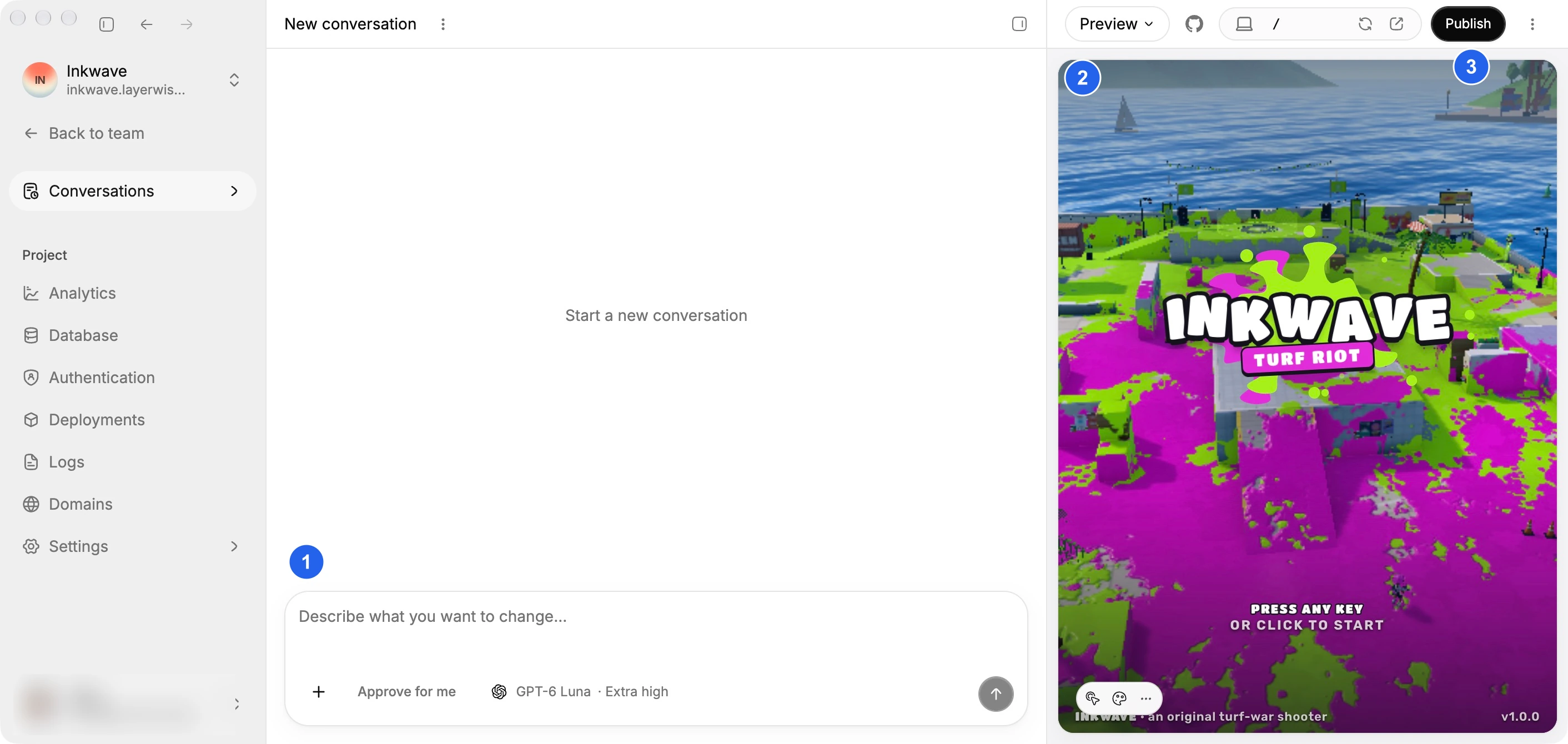
Trade-offs vs Lovable: Layerwise is a desktop app, and the local workspace needs to stay available until publishing completes. It focuses on web apps, and its built-in authentication is email-based: sign-in, verification, and password reset.
The Free plan uses supported open-weight models with up to 10 messages per day; advanced closed-weight models start on Pro. Moving the app to different hosting may require changes to its backend, authentication, and deployment configuration.
Starting price: Free is $0 with $5 in monthly AI credits and one public project. Pro is $15/month with $15 of included monthly AI credits, and Business is $30/month with $30. See Layerwise plans.
2. v0 by Vercel: Next.js apps on Vercel
Who it's for: Product managers, designers, engineers, and founders who want to build with Next.js and deploy on Vercel. Vercel describes v0 as an AI agent that helps anyone create code and full-stack apps.
What it does well: v0 defaults to Next.js and deploys to Vercel, with preview deployments for working branches and a stable production URL. Its GitHub integration works with branches, pull requests, and CI checks.
The model picker chooses the model for your chats, and the pricing page lists per-token prices for v0 Mini, v0 Pro, v0 Max, and v0 Max Fast. ChatGPT Plus and Pro subscribers can connect their ChatGPT plan to cover eligible responses from supported OpenAI models.
Trade-offs vs Lovable: v0 adds databases through Vercel Marketplace integrations such as Supabase, Neon, Upstash, and Vercel Blob. Adding one provisions an account with that provider, rather than using a single built-in backend.
Paid plans are priced per user, while Lovable prices by credits. The updated model picker, which can add custom models from the AI Gateway catalog, is available to Enterprise teams.
Starting price: Free is $0 with a 7-message daily limit. Plus is $30/user/month with $30 of included monthly credits per user, according to the v0 pricing docs. For a closer look, read Layerwise vs v0.
3. Bolt: build in the browser with Bolt Cloud
Who it's for: People who want nothing to install. Bolt runs in the browser and builds websites, web apps, and, through its Expo integration, mobile apps.
What it does well: Bolt Cloud provides databases, hosting, and domains. You can publish to a free bolt.host address, and the Bolt database includes authentication, file storage, server functions, and logs. Pro and Teams users can choose Supabase instead.
Bolt can also import a GitHub repository or a Lovable project.
Trade-offs vs Lovable: Bolt offers a choice of agents, Standard and Max, and handles model selection behind the scenes. Like Lovable, it does not offer a direct model picker for building.
The free plan includes only the Standard agent, and custom domains require Pro. Bolt has also tested Bolt Forge, a research-preview agent that uses open-source models; check its documentation for current availability.
Starting price: Free includes 1M tokens per month with a 300K daily limit. Pro is $25/month billed monthly and starts at 10M tokens per month, according to Bolt pricing. Read Layerwise vs Bolt for more detail.
4. Replit: a cloud workspace beyond web apps
Who it's for: Builders who want an agent and a cloud development environment in one place, including for web apps, mobile apps, slide decks, and data visualizations.
What it does well: Core includes Replit Agent with Free Mode, paid Power and Max modes, Plan mode, Design Canvas, and a Visual Editor.
Replit provides a managed Postgres database with separate development and production environments. Core publishes unlimited apps with built-in logging and analytics, and Replit documents building native iOS and Android apps.
Trade-offs vs Lovable: Replit gives you more model control than Lovable in its paid modes. Free Mode always uses automatic routing, while Power and Max modes let Core and Pro builders choose Auto or select a primary model. Paid work uses effort-based pricing.
As with Lovable, monthly credits apply to both Agent and paid services such as publishing and database storage, so estimate both together.
Starting price: Core is $20/month, or $18/month billed annually, and includes $20 toward more powerful models, according to Replit pricing. Compare the details in Layerwise vs Replit.
5. Base44: a no-code builder with a managed backend
Who it's for: People who prefer a no-code builder. Base44 builds the design, data, user management, and hosting from your description.
What it does well: Base44 includes a managed backend, authentication, and hosting. Its pricing page lists an analytics dashboard, a visual editor, and user management on every plan. The AI chat has Build, Discuss, and Edit modes.
Base44 also documents migrating a Lovable project, including its Supabase data.
Trade-offs vs Lovable: Base44 uses automatic model selection and lets you choose a model manually; its pricing page lists AI model selection from the Builder plan. Plans include two allowances, message credits and integration credits. In-app code edits start on Starter and GitHub integration starts on Builder.
Starting price: Free includes 25 message credits and 100 integration credits per month. Starter is $16/month billed annually, with 100 message credits and 2,000 integration credits. Base44 lists annual prices and says annual billing saves 20%.
6. Claude Code: a coding agent for your own stack
Who it's for: Developers who already have a repository, a deployment process, and preferred services.
What it does well: Anthropic describes Claude Code as an agentic coding tool that reads your codebase, edits files, runs commands, and integrates with your development tools. It is available in the terminal, IDE, desktop app, and browser.
The desktop app can preview a running app, and you can configure which Claude model it uses.
Trade-offs vs Lovable: Claude Code is not a hosted app builder. You choose and connect your database, authentication, hosting, and monitoring. That flexibility suits established projects, but a new app needs more setup than in Lovable.
Starting price: Claude Code is included in the Claude Pro plan at $20/month billed monthly, or $17/month with annual billing, according to Claude pricing.
Layerwise keeps project files on your computer, so you can already open a Layerwise project with Claude Code. Direct integration with your local Codex or Claude Code is coming soon. Read Layerwise vs Claude Code for the full comparison.
How to choose a Lovable alternative
Start with the reason you are leaving or comparing:
- You want to choose the building model and see token prices: Layerwise lets you pick across providers. v0 publishes token prices for its own models, and Replit lets you select a model in Power and Max modes.
- You want local project files: Layerwise builds in a local workspace. Claude Code works in the repository you already have.
- You want to stay in the browser: Bolt, v0, Replit, and Base44 all work as hosted builders.
- Your app runs on Next.js and Vercel: v0 fits that stack most closely.
- You need native mobile apps: Replit and Bolt both document mobile app workflows.
- You prefer no-code with a managed backend: Base44 is designed for that.
- You want a live app to keep running when building credits run out: In Layerwise, exhausting AI building credits alone does not pause your published app.
- You want building, backend, and hosting on one browser-based platform: Lovable may still be the right fit.
Compare what each starting plan includes
| Starting paid plan | Monthly price | Included AI usage |
|---|---|---|
| Layerwise Pro | $15 | $15 in monthly AI credits |
| v0 Plus | $30 per user | $30 in monthly credits per user, plus $2 in free daily credits |
| Bolt Pro | $25 | Starts at 10M tokens per month, with no daily limit |
| Replit Core | $20 | $20 toward more powerful models, plus up to 30 hours of Free Mode chat |
| Base44 Starter | $16, billed annually | 100 message credits and 2,000 integration credits per month |
| Claude Pro | $20 | Includes Claude Code |
| Lovable Pro | $25 | 100 monthly credits, plus 5 daily build credits |
These allowances use different units. A dollar of credits, a token, and a message credit do not represent the same amount of building work, so compare plans by running the same task.
Test a representative feature
Test one representative feature in your top two choices. Build a form that saves data, add sign-in, and publish it. Check that it works with a second account, then review what the task cost. That gives you better evidence than a feature list.
Frequently asked questions
What is the best Lovable alternative?
It depends on the gap you want to close. For model choice, local files, and built-in app services, try Layerwise. For Next.js on Vercel, try v0. For a browser-based builder with hosting, try Bolt or Base44. For a cloud workspace that also covers mobile, try Replit. For an existing codebase, try Claude Code.
Which Lovable alternatives let me choose the AI model?
Layerwise lets you choose supported models across providers for each conversation. v0 has a model picker with its own models, Replit allows model selection in Power and Max modes, and Base44 lists model selection from its Builder plan. Claude Code uses Claude models. Bolt lets you choose an agent while it selects the underlying models.
Is there a cheaper alternative to Lovable?
Layerwise Pro starts at $15/month, compared with $25/month for Lovable Pro as of October 11, 2026. Base44 Starter is $16/month billed annually, and Replit Core is $20/month. Each product measures usage differently, so the total cost of building your app depends on the model, the number of iterations, and the services it uses.
Can I move a Lovable project to another tool?
Lovable supports Git sync and, on paid plans, codebase download. Bolt and Base44 both document importing Lovable projects. Moving an app's database, authentication, and hosting to a different provider usually needs additional work, so test the migrated app before switching users over.
Do I own the code I build with these tools?
You retain rights to the content you create with Layerwise, including generated apps, and the source files stay on your computer with GitHub and ZIP export. Lovable and v0 also document GitHub sync. Check each vendor's terms for the details that apply to your plan.
For the complete Layerwise workflow, follow the quick start or Build a Full-Stack Web App with AI.
YOUR NEXT PROJECT
Give your idea a live URL.
Choose your model, build in a live preview, and publish with your project’s backend connected.
Download LayerwiseBuild your first app