Best Canny Alternatives in 2026
Compare Canny alternatives in 2026, including Layerwise, Featurebase, Frill, Sleekplan, UserVoice, and Fider, on pricing, free plans, and trade-offs.
Table of contents
The right Canny alternative depends on what drives your bill and what you need around the board: who counts as a user, how many teammates need seats, which integrations you rely on, and whether you want to own the app. This guide compares six options against Canny, starting with Layerwise, which we make.
Canny is a mature feedback platform. Its portal covers feedback boards, voting, a roadmap, and a changelog, and its Autopilot AI, included in all plans, captures feedback from support and sales conversations in tools like Intercom, Zendesk, and Gong and merges duplicates. For many product teams, that is the right fit. Others outgrow the free plan quickly or need a feature from a higher tier.
Published by Layerwise. Layerwise is our product, so it appears first. Prices and features were checked against official sources on October 20, 2026. Availability varies by plan and region.
Why people look for Canny alternatives
A few details on Canny's pricing page lead teams to compare:
- Pricing follows tracked users. Canny counts anyone who posts, votes, or comments as a tracked user, including actions an admin or Autopilot takes on their behalf. Free includes 25 tracked users and 5 managers. Pro starts at $79/month billed yearly, with 100+ tracked users and 10 managers, and the price rises as you track more people.
- Passing the limit can change your plan. Without a spend limit, Canny moves you to the next tier when you exceed your tracked users and charges a prorated amount. With a spend limit, it stops tracking feedback from new users once you reach it.
- Common workflow features start on Pro. Custom domains, custom statuses, user segmentation, Zapier, and project management integrations with Jira, Linear, ClickUp, Asana, GitHub, and Azure DevOps are not included on Free.
- Enterprise features sit on Business. SSO integrations with Okta, OIDC, Entra ID, and OneLogin are listed for Business, which is priced on request. HubSpot and Salesforce integrations and removing Canny branding are marked as paid extras on Business and aren't available on Free or Pro.
None of these is a problem for every team. If your board is open to a large user base, or you need a feature from a higher tier, the options below package and price feedback differently.
Canny alternatives at a glance
| Tool | Best for | What stands out | Free plan | Starting paid plan |
|---|---|---|---|---|
| Layerwise | Owning a feedback app and its data | Wishbox template: a board and roadmap per project, voting, merging | 1 public project, 10 sign-in emails/day | Pro: $15/month per team |
| Featurebase | Feedback, help desk, and help center in one tool | Changelog, in-app widgets, and issue sync from Growth | 1 seat, 1 board, 1 roadmap | Growth: $29/seat/month, billed yearly |
| Frill | Flat plans with unlimited admins | Ideas, roadmap, announcements, and a widget on one board | 14-day trial | Startup: $25/month |
| Sleekplan | Small teams on a tight budget | Feedback, changelog, and NPS/CSAT, priced per workspace | Indie: 1 admin, board and changelog | Starter: $15/month |
| UserVoice | Large organizations with CRM-linked feedback | Salesforce, Gainsight, Jira, and Azure DevOps integrations | 30-day trial after a demo | Not published |
| Fider | An open-source board you can self-host | AGPL-3.0 code with free self-hosting | Hosted: up to 250 feedback items | Pro: $25/month |
| Canny (reference) | Capturing feedback from support and sales with AI | Autopilot, changelog, and widget on every plan | 25 tracked users, 5 managers | Pro: from $79/month, billed yearly |
Prices are monthly starting prices with monthly billing unless noted, checked on October 20, 2026. Featurebase charges per seat, and Canny's price rises with tracked users. Layerwise, Frill, Sleekplan, and Fider list flat plan prices.
1. Layerwise: build your own feedback board from the Wishbox template
Who it's for: Teams whose feedback process doesn't fit a packaged tool, or whose bill grows with every voter. Wishbox suits teams that run boards for several products or clients, want ideas and votes in a database they control, or want to sell a feedback service of their own.
What it does well: Wishbox is a feedback SaaS starter. Teams sign up and create projects from a dashboard, and each project gets a public feedback board, a roadmap, and idea pages. Visitors post ideas with rich text, vote once per idea, and comment. Boards have search, category and status filters, and Top, Newest, and Trending sorting, and similar ideas appear while someone types a title.
From the dashboard, the team changes statuses with a public update note, hides ideas, merges duplicates along with their votes and comments, and manages categories, teammates, and settings. The server enforces who can moderate.
Open the live demo board to see what visitors see. How to Build a Product Feedback SaaS with AI walks through sign-in, voting rules, testing, and publishing. The source code is public on GitHub.
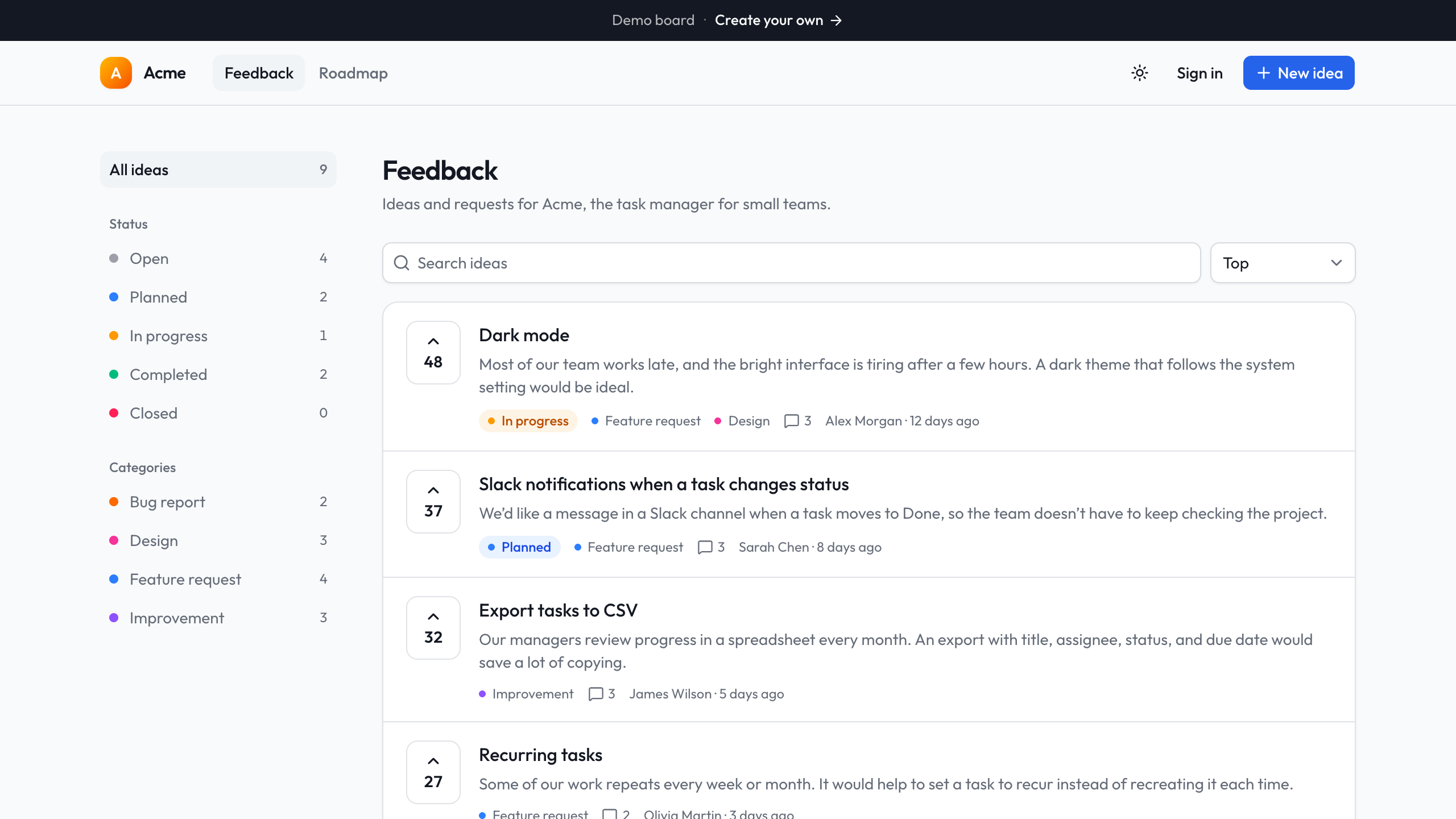
On the template page, Use this template opens Layerwise and copies Wishbox into a project on your team. Then you describe changes in chat, and the assistant edits the project files on your computer while you check them in a local preview. Every project includes a production database, email authentication, app email, publishing, analytics, and server logs.
Pricing is the main contrast with Canny. No Layerwise plan caps how many people sign up to your app; only authentication emails have a daily limit. Plans are priced per team, so a new teammate adds no seat fee.
Trade-offs vs Canny: You own the app, so you also maintain it, and each change uses AI credits or your ChatGPT plan through My Codex. Wishbox has no changelog, in-app widget, email notifications, AI feedback capture, importer, or integrations with Jira, Linear, Slack, or Intercom. It has no SSO or way to recognize users already signed in to your product, and boards can't each have their own custom domain. You would build and test any of those yourself; the template page includes a starting prompt for a changelog.
Visitors sign in on the board with an email and password or an email sign-in code. Each code or password reset counts toward the daily sign-in email limit: 10 a day on Free, and 100 per project (300 per team) on Pro. Layerwise builds web apps only, with no native mobile apps, and the desktop app needs to stay open while you build and publish. New projects on paid plans start private, so turn off Private before you share a board.
Starting price: Free is $0 with one public project, $5 in monthly AI credits, up to 10 messages a day, a 100 MB database, and a Layerwise badge. Pro is $15/month ($150/year) with $15 in monthly AI credits, custom domains, a 1 GB database per project, up to 10 team members, and no badge. Business is $30/month with 500 sign-in emails per project per day and unlimited members. Running out of AI credits doesn't pause a published board. See Layerwise plans.
2. Featurebase: feedback alongside a help desk
Who it's for: Teams that want feedback boards, a roadmap, and a changelog in the same subscription as live chat, a help center, and a ticket inbox. Featurebase's pricing page says these products live in one subscription.
What it does well: The free plan includes unlimited end users and feedback, one board, and one roadmap. Growth adds embeddable in-app widgets, a custom domain, customizable statuses, a public changelog page, AI duplicate suggestions, and integrations with Linear, Jira, ClickUp, GitHub, Slack, Discord, Intercom, and Zendesk. Featurebase also offers automatic migration from Canny, Productboard, Frill, and Beamer.
Trade-offs vs Canny: Featurebase charges per seat, so cost follows the size of your team. The free plan has one seat and no integrations. Portal single sign-on, which signs users in through your own system, starts on Professional at $59/seat/month billed yearly. Admin SSO with SAML or OIDC requires Enterprise with at least five seats, and removing Featurebase branding costs an extra $69/month on Professional and above. Paid plans also include help desk tools that matter less if you only need a feedback board.
Starting price: Growth is $29 per seat per month, billed yearly, plus $0.49 per resolution from its AI support agent. Featurebase offers a 10-day free trial, and annual billing saves 20%.
3. Frill: flat plans with unlimited admins
Who it's for: Teams that want an ideas board, a roadmap, and announcements, with every teammate included. Frill's pricing page says its pricing is plan-based, with unlimited team members and widgets on every paid plan.
What it does well: Frill combines ideas, a roadmap, announcements, and an embeddable widget. Its pricing table lists unlimited tracked users, similar idea detection, smart merge, and a Canny import. Its integrations include Jira, Linear, Trello, Slack, Intercom, Zendesk, Zapier, Okta, and Microsoft Entra ID.
Trade-offs vs Canny: Frill uses a single board by design, with unlimited topics for organizing ideas. The Startup plan caps active ideas at 50. A private, invite-only board and white labeling come with Growth at $149/month or as add-ons, and Frill says most integrations are available on paid plans. Every paid plan has a 14-day free trial.
Starting price: Startup is $25/month with 50 active ideas. Business is $49/month with unlimited ideas.
4. Sleekplan: a free board and changelog for small teams
Who it's for: Small teams and solo founders who want a feedback board, a changelog, and in-app announcements at a low price. Sleekplan's pricing page lists unlimited tracked users and feedback items on every plan.
What it does well: The free Indie plan includes the feedback board, changelog, and email and in-app announcements for a single admin. Starter adds three team seats, the roadmap, CSAT and NPS surveys, a private board, SSO, and integrations such as Intercom, GitHub, Slack, Zapier, and Jira.
Trade-offs vs Canny: The roadmap isn't on the free plan. Removing Sleekplan branding and using a custom domain require Business, which includes 10 team seats at $45/month, or $38/month billed yearly. Plans also have monthly allowances, such as 1,000 announcement views and 500 email sends on Indie. Pricing is per workspace, and each workspace is billed separately.
Starting price: Starter is $15/month, or $13/month billed yearly, with a 30-day free trial.
5. UserVoice: enterprise feedback with a guided rollout
Who it's for: Larger organizations that want feedback connected to CRM, support, and engineering systems, with help setting it up.
What it does well: UserVoice's pricing page describes a centralized feedback portal, feedback capture tools, customer segmentation, and advanced filtering and sorting, with bulk import by CSV or API. Its integrations include Salesforce, Gainsight, Jira, Zendesk, Azure DevOps, Microsoft Teams, Slack, and Fullstory.
Trade-offs vs Canny: UserVoice doesn't publish prices. You book a demo to get a 30-day trial workspace, and the page says most teams launch in four to six weeks.
Starting price: Not published. UserVoice says plans are based on feedback volume, the tools you use, and the integrations you connect, and never on seats.
6. Fider: open source and self-hostable
Who it's for: Teams that want a simple feedback board, or want to run one on their own servers. Fider's code is open source on GitHub under the AGPL-3.0 license.
What it does well: The hosted version is free under a fair use limit of 250 feedback items, with unlimited customers, voting, and members, according to Fider pricing. Self-hosting is free; the hosting docs call for Docker, PostgreSQL 12 or later, and an email provider, with optional sign-in through Google, GitHub, and other OAuth providers.
Trade-offs vs Canny: Fider concentrates on the feedback portal. Its pricing page doesn't name specific integrations or list a changelog, so check its docs for anything beyond the board. If you self-host, you run and maintain the instance, including its database and email delivery.
Starting price: Pro is $25/month, billed month to month, and adds content moderation, unlimited feedback items, and SEO indexing.
How to choose a Canny alternative
- You don't want costs to rise as more customers vote: Layerwise doesn't cap app users on any plan, and Frill and Sleekplan list unlimited tracked users. Fider's free hosted plan includes unlimited customers up to its 250-item fair use limit.
- You want every teammate included: Frill includes unlimited admins on paid plans. Layerwise prices per team, with up to 10 members on Pro and unlimited members on Business. Featurebase charges per seat.
- You want issue tracker sync: Featurebase, Frill, Sleekplan, and UserVoice all list Jira, and Featurebase, Frill, and Sleekplan also list Linear.
- You want a changelog and an in-app widget: Featurebase, Frill, and Sleekplan include announcements or a changelog alongside a widget. Wishbox has neither yet.
- You want feedback and customer support in one tool: Featurebase.
- You want to self-host open-source code: Fider.
- You need enterprise integrations and onboarding help: UserVoice.
- You want to own the app, change any rule, or sell feedback boards to other teams: Start from Wishbox in Layerwise.
- You want AI that pulls feedback from support and sales conversations: Canny includes Autopilot on every plan, so Canny may still be the right fit.
Frequently asked questions
What is the best free Canny alternative?
Featurebase's free plan includes unlimited end users, one board, one roadmap, and one seat, and Sleekplan's Indie plan includes a board and changelog for one admin. Fider's hosted plan is free up to 250 feedback items, and its open-source code is free to self-host. Layerwise Free includes one public project, so you can publish a Wishbox board at no cost, with a limit of 10 sign-in emails a day.
Is there a Canny alternative without per-user pricing?
Yes. Frill and Sleekplan list unlimited tracked users, and Frill includes unlimited admins on paid plans. Layerwise plans are priced per team, with no cap on how many people sign up to your app; only sign-in emails have a daily limit. Featurebase doesn't charge for end users, but its paid plans are priced per seat.
Can I build my own Canny alternative?
Yes. In Layerwise, start from the Wishbox template, which already includes public boards, a roadmap, voting, comments, status updates, and merging, then describe changes in chat. The step-by-step tutorial covers testing and publishing. You maintain the app and add integrations or notifications yourself.
Can I move my feedback out of Canny?
Canny lets you export feedback as a CSV file and pull feedback, votes, users, and companies through its API. Featurebase offers automatic migration from Canny, and Frill's pricing page lists a Canny import. Wishbox has no importer, so you would describe one to the assistant and test it before switching.
How much does Canny cost?
Canny Free covers 25 tracked users and 5 managers. Pro starts at $79/month billed yearly, with 100+ tracked users, and Business is priced on request. A tracked user is anyone who posts, votes, or comments, so the price grows with the number of customers who give feedback.
YOUR NEXT PROJECT
Give your idea a live URL.
Choose your model, build in a live preview, and publish with your project’s backend connected.
Download LayerwiseBuild your first app